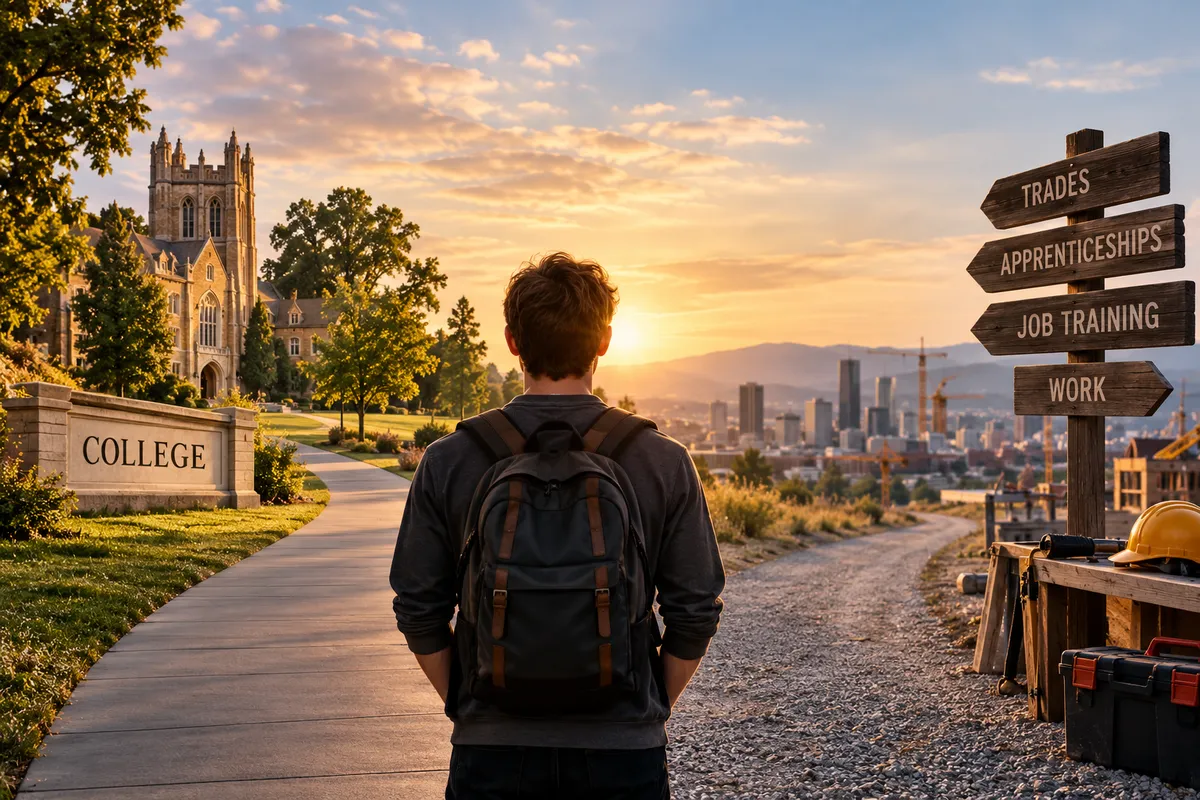
Not Everyone Needs to Go to College. But We Should Be Careful What We Give Up.
Not Everyone Needs to Go to College. But We Should Be Careful What We Give Up.
There is a growing sentiment in America that perhaps we have pushed college too hard.
The argument is understandable. College is expensive. Student debt can follow graduates for decades. Not every degree leads directly to a high-paying career. Meanwhile, skilled trades can provide excellent incomes without requiring four years at a university, and companies are increasingly experimenting with their own training programs that offer young people a direct pathway into employment.
There is truth in these criticisms.
But in responding to the problems with higher education, we should be careful not to discard the purpose of education itself.
The question should not simply be, “Do you need a college degree to get a good job?”
Of course you don't.
The more important question is: What kind of person is an education supposed to produce?
Education Was Never Supposed to Be Just Job Training
One of the oldest ideals of education was the development of a well-rounded person.
The Renaissance gave us the concept we now describe as the "Renaissance man": someone capable of engaging with many different areas of human knowledge rather than being confined to a single specialty. Traditional liberal education carried forward a similar idea.
Students studied mathematics, science, literature, history, philosophy, language, and art not because every subject would eventually appear in their job description, but because each taught them something about how to think.
Mathematics teaches logical reasoning. Science teaches us to examine evidence and revise our beliefs. History teaches us to understand events in context. Literature asks us to interpret language, perspective, and human behavior. Writing forces us to organize our thoughts well enough that another person can understand them.
These skills do not prepare someone for one occupation. They prepare someone to encounter problems they have never seen before.
That distinction matters.
The Real Problem Is Cost—and Colleges Need to Take More Responsibility
There is, however, an enormous problem that defenders of college should acknowledge: college can be far too expensive.
Telling an 18-year-old to borrow an extraordinary amount of money without seriously considering the likely economic return is not responsible educational advice. A $200,000 education does not automatically become a good investment because education itself is valuable.
We need to distinguish between two questions:
Is higher education valuable?
and
Is every college degree worth any price?
The answer to the first can be yes while the answer to the second is clearly no.
Students and families should consider cost, scholarships, expected debt, graduation rates, career possibilities, and likely financial outcomes. But colleges also need to take more responsibility for what happens after graduation.
If an institution is going to charge students tens or even hundreds of thousands of dollars for an education, its responsibility should not end when the student completes the required credits.
I remember going to my own college career center and discovering that some of the people advising students were other students—some the same age as I was. I couldn't help but wonder: how was someone who had never navigated a professional career themselves supposed to teach me how to navigate mine?
To borrow from John Mulaney, it felt a little like “a horse watching over a dog.”
Career services should not be a peripheral student service. Colleges should be aggressively tracking employment outcomes, building relationships with employers, creating internship and recruiting pipelines, leveraging their alumni networks, and employing experienced professionals who understand how industries actually hire.
Universities devote enormous attention to measuring who gets in, who enrolls, who stays, and who graduates. They should be equally serious about what happens next.
The student-debt problem is a reason to make college more affordable and accountable. It is not a reason to abandon the educational model itself.
Training and Education Are Not the Same Thing
This distinction is becoming increasingly important as alternatives to college emerge.
Consider a student who enters an employer-sponsored technology program immediately after high school. The program may be excellent. Perhaps the student spends two years learning exactly what the company needs, demonstrates proficiency, and receives a job.
At 20 years old, that can look considerably more efficient than spending four years in college.
But efficiency depends on what we are optimizing for.
What happens at 32 if that technology changes? What happens if the company restructures? What happens if the industry contracts? What happens if the student simply discovers that he doesn't want to do that work anymore?
There is nothing wrong with occupational training. But training and education solve different problems.
Training asks: What do you need to know to perform this job?
Education asks: What do you need to know to learn, reason, solve problems, and adapt?
Ideally, we should have both.
This is also why the much-maligned general education requirement still has value. An engineering student may study history. A biology major may take philosophy. An English major may need mathematics or science.
Students frequently ask, “Why do I need to take this? It has nothing to do with my major.”
That is precisely the point.
Your education is supposed to be larger than your major.
Education Creates Options
One of the strangest assumptions in the modern debate over college is that a degree is valuable only when the graduate works in the exact field printed on the diploma.
Real careers are rarely that tidy.
People study history and enter business. They study engineering and become entrepreneurs. They study biology and enter consulting. They study English and work in technology. People change careers, start companies, return to school, and enter industries that may not even have existed when they were freshmen.
That doesn't mean their degrees were wasted.
The durable part of an education is often what transfers: the ability to learn quickly, communicate clearly, analyze unfamiliar information, manage deadlines, defend an argument, and solve problems without being given step-by-step instructions.
A degree can also signal to an employer that someone successfully navigated a multiyear system of expectations, deadlines, difficult assignments, and accountability. It doesn't guarantee intelligence, competence, or work ethic, but it can provide evidence of those qualities.
Most importantly, education preserves the ability to change direction.
College vs. the Trades Is a False Choice
None of this is an argument against the trades.
America needs electricians, plumbers, welders, mechanics, machinists, technicians, and other skilled professionals. Many of these careers provide excellent incomes and meaningful work. For some students, trade school or an apprenticeship will absolutely be the right choice.
But why should we treat being educated and working with your hands as competing paths?
Why shouldn't an electrician understand economics? Why shouldn't a welder study history? Why shouldn't a carpenter be an excellent writer?
And why shouldn't someone with a bachelor's degree decide to become a plumber?
A well-educated 22-year-old can still enter a trade. The education doesn't close that door. It leaves other doors open as well.
That matters because industries change. Technology changes. Economies change. People change.
A specialized skill may serve someone extraordinarily well for decades. But if an industry becomes saturated, automated, outsourced, or obsolete, a person whose entire education was designed around that occupation may have fewer options.
The objective should be to give young people more doors, not fewer.
We Should Want an Educated Society
There is also a reason to care about education beyond an individual's salary.
A society benefits when more of its citizens understand mathematics, science, history, literature, economics, government, and logical reasoning.
An educated tradesperson may become an entrepreneur. An educated business owner may make better decisions. An educated parent may be better equipped to help a child navigate the world. An educated voter may be better prepared to evaluate evidence and distinguish a strong argument from a misleading one.
None of these outcomes requires a college degree, and possessing a degree certainly does not guarantee them.
But they remind us why education has historically been understood as something larger than workforce preparation.
We should expand apprenticeships. We should celebrate skilled trades. We should welcome new approaches to occupational training. We should demand that colleges control costs, demonstrate outcomes, and do a far better job helping their graduates find careers.
But we should not make the opposite mistake and reduce education to the shortest possible path between adolescence and a paycheck.
A good education should do more than prepare an 18-year-old for the job market of today.
It should prepare that person for a world that will change repeatedly over the next 50 years.
The best education does not tell students what they must become.
It gives them the intellectual tools—and the freedom—to decide for themselves.
